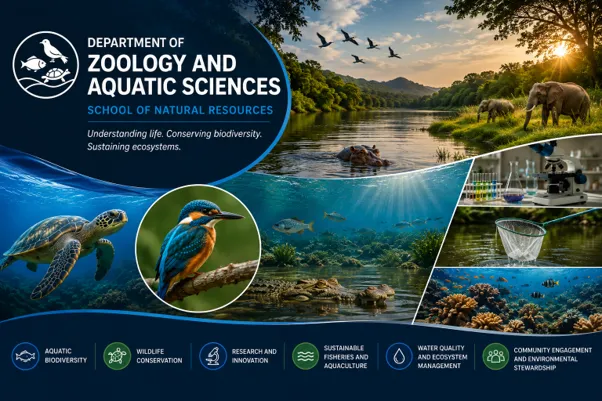
Zoology and Aquatic Sciences (ZAS)
Overview
The Department of Zoology and Aquatic Sciences was established in 2009 to provide education, research, and professional training in the conservation, sustainable management, and utilisation of animal and aquatic resources. The Department was founded in response to the increasing need for skilled professionals capable of addressing challenges related to biodiversity conservation, fisheries and aquaculture development, wildlife management, ecosystem health, and environmental sustainability.
The Department offers degree programmes designed to develop graduates with the knowledge and practical skills required to sustainably manage terrestrial and aquatic ecosystems while promoting biodiversity conservation, food security, and climate resilience. Through teaching, research, innovation, and community engagement, the Department contributes to the sustainable use of wildlife and aquatic resources for national and regional development.
Vision
To be a leading teaching, research and innovation department recognised for excellence in zoology, fisheries, aquaculture, wildlife conservation, and aquatic sciences, advancing scientific discovery, biodiversity conservation, and the sustainable management of terrestrial and aquatic ecosystems.
Degree Programmes
The Department offers the following programmes:
BSc in Animal Science
BSc in Global Conservation and Sustainable Development
BSc in Fisheries and Aquaculture
BSc in Wildlife Management
MSc/MPhil/PhD Tropical Ecology and Biodiversity Management
Currently, all undergraduate programmes are offered on a full-time basis. Postgraduate programmes are available through both full-time and distance learning modes. Applicants seeking admission to a postgraduate programme must hold a first degree in a relevant field from a recognised and reputable institution.
Research Interests
The Department conducts research, innovation, and consultancy in several interrelated areas, including:
Animal biology and evolution
Wildlife Systematics
Aquatic and Terrestrial ecology
Conservation Biology
Population ecology and Population Genetics
Conservation Biology
Wildlife Management
Ethology
Avian biology and ecology
Climate Change and Sustainable Development
Biodiversity Resource Assessment
Environmental Management
Socio-ecological Systems and Human Dimension
Published:
20th March 2026